
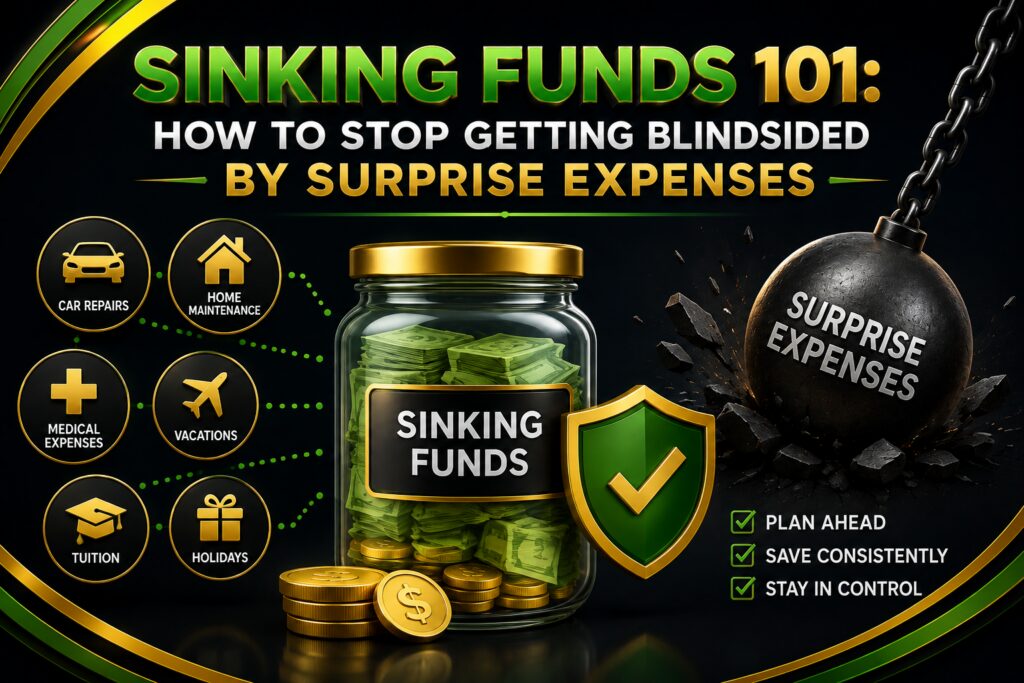
Sinking Funds 101: How to Stop Getting Blindsided by “Surprise” Expenses

By David Samuel
Everyday Finance Coach
If you’ve ever said, “I don’t know where my money went, it was just one thing after another,” I want to introduce you to the tool that will change that sentence forever: the sinking fund.
Here’s the truth most people don’t want to hear — that $600 car repair, the $1,200 annual insurance premium, the $400 holiday shopping bill, the new set of tires you knew you’d need eventually? None of those were actually surprises. You knew they were coming. You just didn’t plan for them. And that’s the real budget-killer for most people: not the unexpected, but the unplanned-for expected.
That’s exactly what a sinking fund is built to solve.
What Is a Sinking Fund?
A sinking fund is a savings strategy where you set aside a little bit of money each month toward a specific, known future expense — so that when the bill arrives, you’re not scrambling, borrowing, or swiping a credit card. You already have the cash sitting there, waiting.
Think of expenses like:
- Car maintenance and registration
- Annual or semi-annual insurance premiums
- Holiday gifts
- Birthdays and anniversaries
- Property taxes
- Annual subscriptions (Amazon Prime, software renewals)
- Home repairs (a new water heater, roof patch, HVAC tune-up)
- Vacations
- Pet vet visits
None of these are emergencies. They’re predictable, recurring costs that just don’t happen every single month — which is exactly why they catch people off guard. A sinking fund breaks a big, lump-sum expense into small, manageable monthly deposits, so the money is ready before the bill is.
Why Is It Called a “Sinking Fund”?
This term didn’t come from personal finance blogs — it’s actually over 200 years old, borrowed from corporate and government finance. Historically, a “sinking fund” was money that a company or government set aside gradually over time to pay off a large debt or bond obligation before it came due. Instead of scrambling to pay a massive lump sum all at once when the debt matured, the organization would make smaller contributions over time until the fund grew large enough to “sink,” or extinguish, that liability entirely.
The word “sinking” refers to the debt being reduced or eliminated — not the money disappearing. Over the decades, the concept was adopted into household budgeting because the logic works identically at a personal level: instead of getting hit with one large, disruptive cost, you gradually “sink” the future expense by pre-funding it in small, steady increments. By the time the expense shows up, it’s already been neutralized.
So in a very real sense, when you build a sinking fund for your car’s next major repair, you’re doing exactly what governments and corporations have done for centuries — just on a household scale.
How to Set One Up (In 4 Simple Steps)
- List your “known unknowns.” Go through the last 12 months of spending and highlight every expense that wasn’t monthly, but wasn’t a true emergency either. These are your sinking fund candidates.
- Estimate the cost and the timeline. For each item, ask: how much will this cost, and when is it due? For a $600 annual insurance premium due in 6 months, you need $100 per month.
- Open separate “buckets.” This is where most people go wrong — they lump everything into one general savings account and lose track of what’s earmarked for what. Use a budgeting app with sub-categories (like EveryDollar or YNAB), or open multiple free sub-accounts at an online bank. Give each fund a name: “Car Repairs,” “Christmas 2026,” “Property Tax.” To maximize your savings, use a high-yield savings account to house your sinking fund.
- Automate the contribution. Set up an automatic transfer the day after payday so the money moves before you’re tempted to spend it elsewhere. Consistency, not size, is what makes sinking funds work.
The Real Payoff
The magic of a sinking fund isn’t just financial — it’s emotional. It removes the dread of “what’s going to break next” and replaces it with quiet confidence. You stop reacting and start responding on your own terms, with cash you already set aside.
If you’ve been living paycheck to paycheck and feel like life keeps throwing curveballs, the reality is that most of those curveballs are actually pop-flies you could have caught with a glove you built in advance. Sinking funds are that glove.
Start with just one. Pick the expense that has bitten you the hardest this year, break it into monthly deposits, and automate it. That one small shift is often the first domino that turns a reactive financial life into a proactive one — and it’s usually the moment things finally start to feel manageable.
If you’re ready to make progress in your effort to take control of your finances, this is exactly the kind of work done with my coaching clients every day—clarifying priorities, creating a practical plan, and following through on it. If you’d like support with your own situation, you’re welcome to reach out anytime right here, or by email at david@everydayfinancecoach.com