
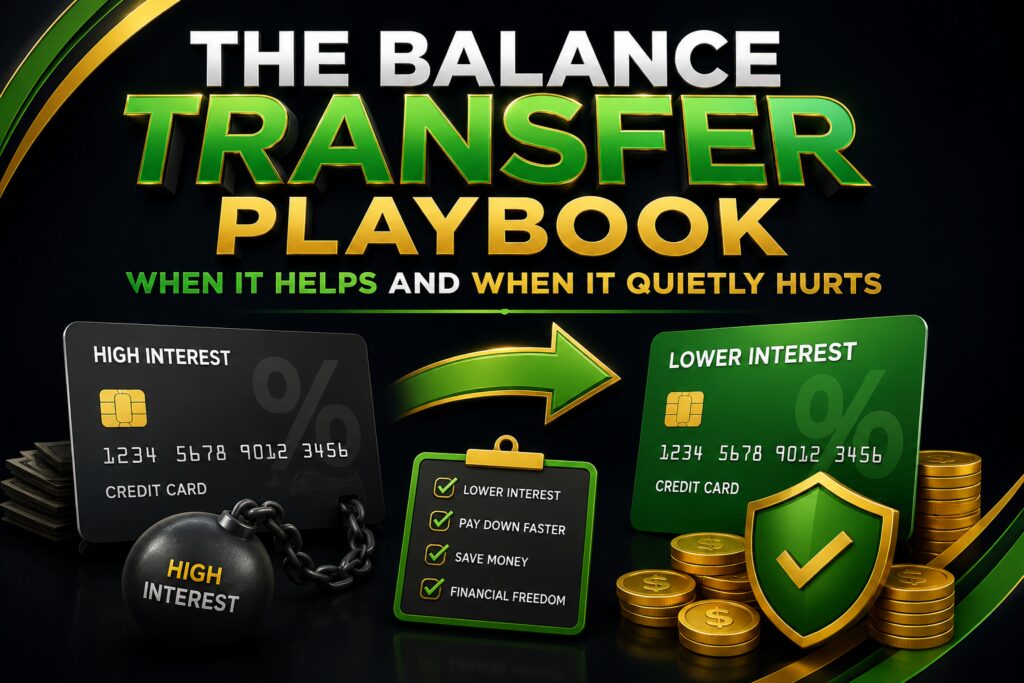
The Balance Transfer Playbook: When It Helps and When It Quietly Hurts

By David Samuel
Everyday Finance Coach
You just got the offer in the mail — or maybe your bank flashed it at you in the app: “0% APR for 18 months.” It feels like a lifeline. Move your high-interest credit card debt over, stop the interest bleeding, and finally make real progress. Sometimes that’s exactly what happens. But a balance transfer can also quietly make things worse, and the difference usually comes down to whether you have a plan or just a promotion.
Let’s break down when this tool actually helps — and when it becomes just another way to postpone the real work.
What a balance transfer actually is
A balance transfer moves debt from one card (usually high-interest) to another card, typically one offering a 0% or low introductory APR for a set window — often 12 to 21 months. In exchange, most issuers charge a transfer fee, usually 3–5% of the balance moved. So a $10,000 balance might cost you $300–$500 upfront in fees, even before a single dollar of interest is calculated.
That fee matters. It’s the first thing that tells you whether this move is strategic or just emotionally satisfying.
When it helps
A balance transfer earns its place in your plan when three things are true at the same time:
- You have a specific payoff number and date. Not “I’ll pay it off eventually,” but “I owe $8,400, and I will pay $467 a month for 18 months to hit zero before the promotional rate ends.” The math has to work backward from the deadline, not forward from whatever’s left over.
- You already know why the debt happened. If you can point to a cause — a job loss, a medical bill, a season of underemployment — the transfer buys you breathing room to recover. If you can’t name a clear cause, the transfer is more likely to fund a repeat performance.
- Your spending system is already stable. This one matters more than people expect. A balance transfer works best on debt that’s sitting still, not debt that’s still growing. If your zero-based budget is in place and your “everything else” bucket isn’t currently outpacing your income, a transfer gives your existing system room to finish the job faster.
Used this way, a transfer isn’t a shortcut — it’s an accelerant on a plan you were already running.
When it quietly hurts
Here’s the trap: a balance transfer removes the most obvious pain point (high interest) without necessarily removing the behavior that created the balance in the first place. That’s what makes it “quiet.” Nothing looks wrong at first.
- Trap 1: The freed-up card becomes available again. You move $6,000 off Card A, and suddenly Card A shows a $0 balance with a $6,000 limit sitting right there. Within a few months, many people have both the transferred balance and a fresh balance building on the original card — now carrying double the debt at a fraction of the awareness.
- Trap 2: The promotional clock runs out faster than the plan. If you transfer $10,000 at 0% for 15 months but only budget “extra when I can,” the leftover balance rolls into a new interest rate — often higher than what you started with — the moment the promo period ends.
- Trap 3: The fee resets the math without you noticing. A 4% transfer fee on $10,000 is $400. If you’re only saving a little in interest because you’re planning to pay it off quickly anyway, the fee can eat most of the benefit, and the “win” becomes mostly psychological.
- Trap 4: It becomes a repeatable habit instead of a one-time tool. Some people transfer balances every 12–18 months indefinitely, chasing the next 0% offer instead of ever finishing the debt. That’s not debt reduction — that’s debt maintenance with better marketing.
The counter-move
Before you transfer anything, write down three numbers: the balance, the exact payoff date you’re committing to, and the monthly payment required to hit it. Then decide today what happens to the now-empty credit line — many people choose to lower that card’s limit or leave it out of their wallet entirely until the transferred balance is gone.
A balance transfer isn’t good or bad on its own. It’s a tool that amplifies whatever system is already running underneath it — a solid zero-based budget and a real deadline, or a habit of moving numbers around instead of paying them down.
If you’re not sure which one describes you right now, that’s worth a honest look before you fill out the next application.
If you’re ready to make progress in your effort to take control of your finances, this is exactly the kind of work done with my coaching clients every day—clarifying priorities, creating a practical plan, and following through on it. If you’d like support with your own situation, you’re welcome to reach out anytime right here, or by email at david@everydayfinancecoach.com