
From Paycheck to Planting Seeds: Mastering Money in Your Spring Season

By David Samuel
Everyday Finance Coach
Winning personal finance in the Spring season of wealth means using your early working years to build systems, habits, and confidence that compound for decades. In my post The Seasons of Wealth: Adapting your Financial Strategy for Every Stage of Life, I defined your “Spring” season as your 20-30s. These are your early earning years—roughly your first major decade or two of work—when your income may be modest but your time horizon is long. This is the sowing season: every dollar you save or invest is a seed that can grow exponentially through compounding, even though the “field” still looks mostly empty.
Spring is also the season of learning, experimentation, and course-correction. You are figuring out how money works in real life—how to handle paychecks, credit, bills, and benefits—and the goal is not perfection but building repeatable behaviors that become second nature.
Design a Springtime “Conscious Money System”
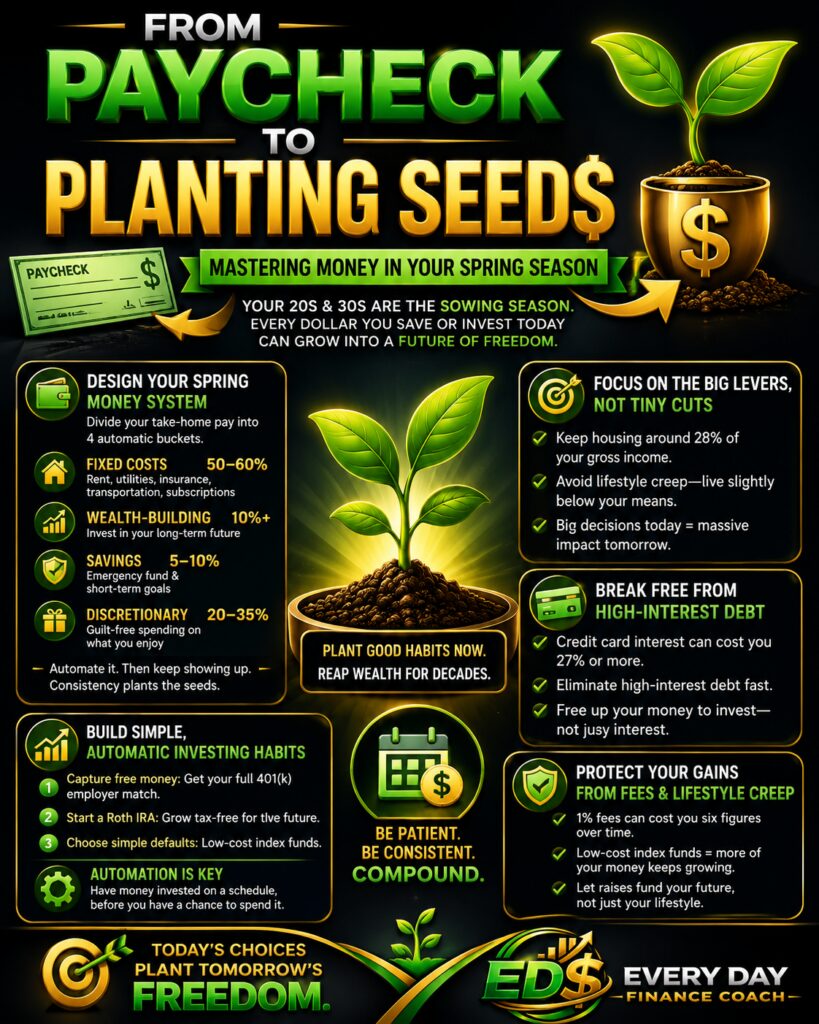
In Spring, your main job is not to master every financial topic, but to design a simple, conscious money system and let it run. A practical structure is to divide your take-home pay into four automatic buckets: fixed costs, wealth-building, savings goals, and discretionary spending.
On a $75,000/year salary, where your take-home income is about $5,000 a month, a Spring-season structure might look like this:
- Fixed costs: 50–60% for rent or mortgage, utilities, insurance, transportation, and subscriptions, paid automatically so you are never late. Spring is where you learn to detect when these costs creep too high and reset them before they trap you.
- Wealth-building: At least 10% for long-term wealth building, even if the absolute dollar amount feels small right now.
- Savings: 5–10% for emergencies and short-term priorities so that unexpected expenses do not derail your progress.
- Discretionary spending: 20–35 % on what you truly enjoy, guilt-free, which keeps the system emotionally sustainable.
Think of this as your Spring season planting map: once your auto-transfers are in place, your primary task is to keep showing up and adding seeds, not constantly redesigning the field.
Focus on the “Big Levers,” Not Tiny Cuts
In the Spring season, it is tempting to obsess over small frugality hacks—skipping coffee, clipping every coupon—because they feel immediate and manageable. However, rather than be overly focused on these small dollar questions, you should instead focus on the $30,000 questions, such as how much you pay for housing, how you handle debt, and whether you are investing at all.
For example, keeping housing around 28% of gross income is a high-impact Spring decision. On a $75,000 salary, that means targeting a total housing cost of about $1,750 a month. Spending several hundred dollars above that can easily cost hundreds of thousands of dollars in lost investment growth over your lifetime. In Spring, deciding to live slightly below your means is one of the most powerful seeds you can plant.
Use Spring to Break Free from High-Interest Debt
Spring is also when many people first meet credit cards, car loans, and student loans, sometimes learning the hard way how costly debt can be. Carrying credit card balances at interest rates around 27% means every $1,000 of balance costs about $270 per year just in interest.
Treat eliminating high-interest debt as a Spring emergency project: the faster you clear it, the more of your future income can be planted into investments instead of poured into interest. This is not just about feeling “caught up”; it is about freeing your future Summer and Fall seasons from the weight of Spring mistakes. See my post: From Overwhelmed to Organized: How to Build a Debt Payoff Plan That Sticks for an accelerated debt payoff approach that can easily work for you.
Build Simple, Automatic Investing Habits
In Spring, it is easy to think, “I’ll invest when I make more,” but this is exactly the season where small, consistent investing has the most leverage. Investing even $300 a month—about $10 a day—in a low-cost total stock market index fund starting at age 25 can grow to over $1 million by retirement at age 60 (almost $2 million if you go to age 65) when you let time and compounding work.
A Spring-friendly sequence is:
- Capture free money: Contribute enough to your 401(k) to get the full employer match if one is offered.
- Start a Roth IRA: If your income allows, open a Roth IRA and automate monthly contributions so future gains can grow tax-free.
- Choose simple defaults: Use low-cost index funds so you are not forced to constantly pick stocks or time the market.
I discuss low-cost index funds in my Total Stock Market Index Funds – Your weapon of choice for long term investing post.
The crucial Spring habit is automation: money should leave your checking account for investing on a schedule, before you have a chance to spend it elsewhere. With simple automation, you have no need to rely on your own will power to save and build wealth. Paycheck Power – Automations That Quietly Grow Your Savings in the Background
Protect Spring Gains from Fees and Lifestyle Inflation
Because Spring portfolios are small, it is easy to shrug off the 1% advisory fee you’d pay for an investment advisor, or the higher expense ratio you’d pay for a managed mutual fund—but those small percentages compound against you. Over decades, a 1% fee can quietly consume six figures of potential wealth, which is the equivalent of uprooting many of the seeds you planted early on. Automated monthly purchases of low-cost index funds require no expertise, no timing and no emotional intelligence. You can easily do this on your own, and the return you’ll earn will amaze you.
Similarly, Spring often brings your first promotions and pay raises, which can trigger lifestyle inflation, where every extra dollar goes toward a more expensive lifestyle instead of more saving and wealth-building. A Spring-friendly rule is to decide in advance that every raise will be split—perhaps 50% to wealth-building, 30% to pay down debts, and 20% for lifestyle upgrades that make your present life better. This way, your future seasons benefit as much as your current one.
Your Spring season can truly be a gift to your future you. Time, not money, is your most important asset. A modest $50-75,000 per year income is actually quite sufficient (once enhanced by an equally modest amount of discipline, automation and compound interest) to live well today and gradually buy your future financial freedom. But time is the super fuel, and you’ll never have more of it than you do by starting in your Springtime. Many of us who didn’t get serious about our personal finance until late-Summer or early-Fall have lived to regret our late start. Let that not be said of you!
If you’re ready to make progress in your effort to take control of your finances, this is exactly the kind of work done with my coaching clients every day—clarifying priorities, creating a practical plan, and following through on it. If you’d like support with your own situation, you’re welcome to reach out anytime right here, or by email at david@everydayfinancecoach.com