
When Life Blows Up Your Budget – How to Reset After a Crisis Without Starting from Zero

By David Samuel
Everyday Finance Coach
When life blows up your budget—a job loss, health scare, divorce, big repair, or any combination of chaos—it can feel like all your careful planning evaporated overnight. The goal right now isn’t perfection; it’s stabilizing, resetting, and rebuilding in a way that doesn’t erase all the progress you’ve already made.
Think of this as your “financial triage and reset” plan: calm the immediate emergency, adapt your budget to your new reality, and then slowly rebuild without starting from zero.
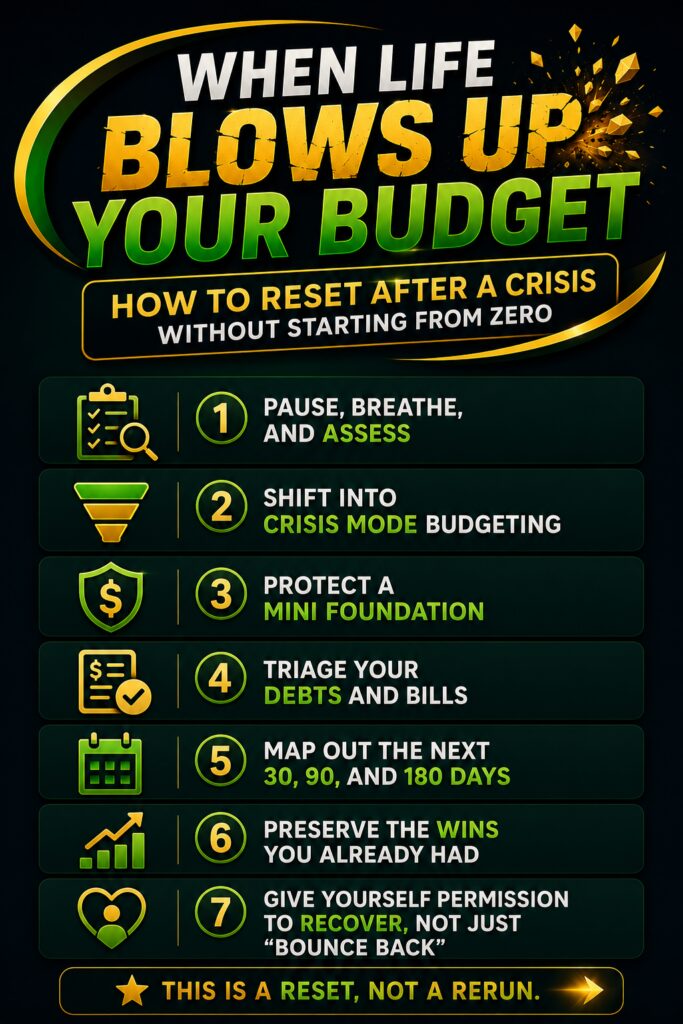
Step 1: Pause, Breathe, and Assess the Damage
Before you open every bill and spreadsheet in a panic, give yourself permission to take a breath. Feeling fear, anger, or grief is normal after a financial shock. What matters is what you do next. When you’re ready, do a quick financial inventory:
- List all current sources of income: job, severance, unemployment, partner’s income, side gigs, temporary help from family, etc.
- List your core monthly expenses: housing, utilities, basic groceries, transportation, insurance, minimum debt payments.
- Note your current savings: checking, savings, any accessible emergency fund.
- Capture any past-due or urgent bills separately so they’re visible.
You’re not making decisions yet; you’re getting a clear picture of where you stand. That clarity alone reduces anxiety and sets up better choices.
Step 2: Shift into “Crisis Mode” Budgeting
In a crisis, your regular budget may no longer fit. You need a temporary crisis budget that helps you stretch what you have without feeling like your life is over. Use a simple three-bucket approach:
- Must keep (essentials):
- Rent/mortgage, utilities, basic food, transportation, insurance, minimum debt payments.
- Pause or cut for now (non-essentials):
- Dining out, entertainment, travel, clothes beyond basics, nonessential subscriptions and memberships.
- Negotiate or reduce:
- Call lenders, landlords, and service providers to ask about hardship options, payment plans, or lower-cost plans.
Your goal in this phase is simple: make sure the essentials are covered for the next 30–90 days while you buy yourself time to adjust and recover.
Step 3: Protect a “Mini Foundation” So You Don’t Go Backwards
When everything feels urgent, it’s tempting to drain every savings account just to feel caught up. But completely emptying your cushion can make the next surprise even harder to absorb. Aim to protect or rebuild a mini emergency fund, even while you’re dealing with the crisis:
- If you still have some savings, decide how much you’re willing to use now and how much you want to keep as a floor (for example, 500–1,000).
- If your savings are already gone, set a realistic starter target and slowly rebuild toward it as income returns or stabilizes.
Think of this mini fund as your “don’t go all the way back to zero” buffer—a small but meaningful barrier between you and the next card swipe or payday loan.
Step 4: Triage Your Debts and Bills
In a crunch, not all bills are equal. That doesn’t mean you ignore obligations; it means you prioritize intentionally. General triage order:
- Housing and utilities – Keep a roof over your head and the lights on.
- Transportation and basic communication – Car payment/insurance if you need it for work, phone/internet at a basic level.
- Minimum payments on debts – To avoid collections and serious credit damage where possible.
- Everything else – Subscriptions, extras, and nonessential categories can be cut or paused.
If you truly can’t meet obligations:
- Contact creditors before you miss payments—many have hardship programs, temporary forbearance, or modified payment options.
- Document all agreements and check your statements to ensure changes are applied correctly.
The aim is not to be perfect; it’s to stay in proactive communication so one crisis doesn’t turn into a string of avoidable penalties and collections.
Step 5: Map Out the Next 30, 90, and 180 Days
Crises feel endless when you look at them as one giant, blurry problem. Breaking time into phases gives you anchors and a sense of progress. Try this:
- Next 30 days (Immediate):
- Focus: survival and stability.
- Actions: cover essentials, cut/trim quickly, secure any benefits or support (unemployment, assistance, severance, etc.).
- Next 90 days (Intermediate):
- Focus: steadying the cash flow.
- Actions: find or adjust work/income, refine your crisis budget, start rebuilding a mini emergency fund, keep creditors updated.
- Next 180 days (Longer-term reset):
- Focus: rebuilding and repositioning.
- Actions: restore a fuller emergency fund, restart or increase retirement contributions, reassess bigger goals and timelines.
You don’t have to know exactly what month six looks like yet; you just need a rough roadmap so you’re not treating a temporary season as your permanent reality.
Step 6: Preserve the Wins You Already Had
A crisis might knock you off track—but it doesn’t erase the knowledge, habits, and progress you’ve already built. Ask yourself:
- “What was working in my finances before this happened?”
- Were you automating savings? Tracking spending? Paying down debt?
- “Which of those habits can I keep alive, even at a smaller scale?”
Examples:
- If you were saving 300/month, maybe you drop to 25 or 50—but keep the automatic transfer alive so the habit stays intact.
- If you were investing regularly, you might pause temporarily while income stabilizes, but you can set a reminder to restart at a specific income level or date.
- If you had a budgeting routine, keep a scaled-back version so you don’t slip into total avoidance.
The mindset shift: you’re adjusting the dial, not smashing the system. That’s how you reset without starting from zero.
Step 7: Give Yourself Permission to Recover, Not Just “Bounce Back”
Money crises are not just math problems; they’re emotional events. Shame and self-blame can quietly sabotage your ability to stick with any plan. A few grounding truths:
- You’re not behind because you failed—it’s because life happened.
- The skills you build now (triage, communication, adaptability) are part of your long-term financial resilience.
- Recovery can be lumpy; some months you’ll make big strides, others you’ll just hold the line. Both count.
If it helps, adopt a small mantra like: “This is a reset, not a rerun,” or “I’m building back better systems, not just plugging holes.”
Your 7-Day “Reset Without Starting Over” Plan
To make this concrete, over the next week you can:
- Do a 30–60 minute financial inventory.
- Create a crisis-mode budget separating essentials from nonessentials.
- Call at least one creditor or provider to ask about hardship or lower-cost options.
- Choose a mini emergency fund target and decide how much you’ll protect or rebuild.
- Pick one habit from “before the crisis” to keep alive at a smaller level.
- Sketch out your 30/90/180-day focus on one page.
- Schedule a check-in with yourself (and your partner, if you have one) to review and adjust in two weeks.
You don’t have to fix everything this month. You just need to take the next few right steps so the crisis becomes a chapter in your financial story—not the whole book.
_________________________________________________________________________________________________
Sidebar: How to Talk to Creditors in a Crisis
Reaching out to creditors can feel intimidating, but a short, proactive call often leads to better options than staying silent and hoping for the best.
Before you call
- List each creditor with: balance, minimum payment, due date, and interest rate.
- Be clear about what changed (job loss, hours cut, medical emergency, etc.) and what you can realistically pay right now.
- Decide your ask: lower payment, temporary pause, due date change, or interest-rate reduction.
During the call
Use a calm, simple script like:
“Hi, my name is ___. I’ve been a customer since___ . I’m going through a temporary hardship due to___ . I want to keep my account in good standing, but I can’t afford the current payment. What hardship options or programs do you have that could help me make smaller payments or pause for a short time?”
Then:
- Ask specifically about hardship programs, forbearance, payment plans, or temporary rate reductions.
- If the first person can’t help, politely ask to speak with a supervisor.
After the call
- Write down: who you spoke with, the date, and exactly what they promised (new payment, timeline, interest rate, fees waived).
- Check your next statement to confirm the changes went through.
- If something doesn’t match, call back and reference your notes.
Remember: their goal is to get paid; your goal is to stay afloat. Coming to them early—with a plan and a willingness to pay what you reasonably can—often leads to more flexible arrangements than waiting until you’re already behind.
_________________________________________________________________________________________________
A crisis can absolutely shake your confidence, but it does not get to tell the whole story of your financial life. You are allowed to move slowly, to adjust your plan as you go, and to count holding steady as a win in hard seasons. Each small action you take—facing the numbers, protecting a mini emergency buffer, choosing one bill to call about, setting up one automatic transfer—is proof that you’re not starting from zero; you’re rebuilding from experience. Your situation may have changed, but your ability to learn, adapt, and move forward is still very much intact, and that’s the real asset you’re carrying into whatever comes next.
If you’re ready to make progress in your effort to take control of your finances, this is exactly the kind of work done with my coaching clients every day—clarifying priorities, creating a practical plan, and following through on it. If you’d like support with your own situation, you’re welcome to reach out anytime right here, or by email at david@everydayfinancecoach.com