
Before the Balance Bloats – How to Build Guardrails Around Your Credit Cards
By David Samuel
Credit cards can be incredibly useful tools—but only if you stay in control. When the balance starts creeping up, interest charges and minimum payments quietly eat into your monthly cash flow and make it harder to hit any of your other goals.
Instead of relying on willpower alone, you can build guardrails—simple, day‑to‑day rules and bits of friction that make it easier to use credit wisely and harder to overuse it.
Rethink your credit card’s job
The first guardrail is mental: your credit card is not extra money. It’s just a different way to move the money you already have.
Try reframing it like this:
- “My credit card is a payment tool, not a source of funding.”
- “If I don’t have the cash in checking (or savings) for it, I don’t put it on the card.”
That mindset shift alone keeps a lot of “I’ll figure it out later” purchases from ever happening.
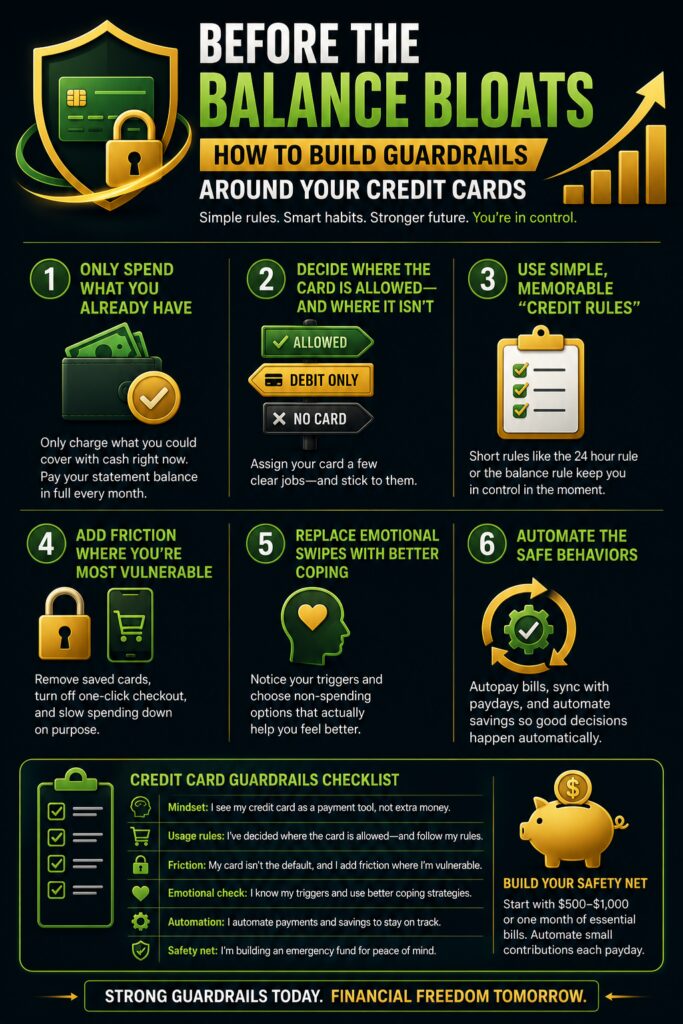
Guardrail 1: Only spend what you already have
One of the cleanest ways to stay out of trouble is to treat your card like a debit card with a delay.
- Only charge what you could cover with cash right now.
- Check your bank balance regularly so you know what you truly can afford.
- Make a personal rule: “I pay my statement balance in full every month.” If you can’t one month, that’s a yellow light telling you the card is doing too much.
If you’re rebuilding trust with yourself, you can even ask the issuer for a lower limit so you literally can’t get as deep into debt if something goes off the rails.
Guardrail 2: Decide where the card is allowed—and where it isn’t
Complicated budgets are hard to follow in real life. Short, easy rules are much easier to remember in the moment. Some examples you can adapt:
- The 48‑hour rule: “No unplanned purchase over 100 on a card without waiting 24 hours.”
- The one-tab rule: “I never buy from the first time I see something—I must close the tab once before I’m allowed to come back and buy.”
- The late-night rule: “I don’t use my credit card after 9 p.m.”
- The balance rule: “If my balance ever goes over 500, I freeze the card until it’s back to zero.”
Pick one or two that fit your life, write them down somewhere you see often, and say them out loud for a week until they’re second nature.
Guardrail 4: Add friction where you’re most vulnerable
Credit cards are powerful because they make spending feel almost effortless. Guardrails add a bit of effort back in, especially in your weak spots.
Ideas:
- Take your card out of your everyday wallet; keep it in a drawer at home and use it only for planned purchases.
- Remove saved card info from shopping sites and apps so you must type the number manually.
- Turn off “one-click” checkout wherever possible.
- Use your phone for bank and budgeting apps first, shopping apps second.
You’re not trying to make spending impossible. You’re just slowing it down enough that your rational brain can catch up.
Guardrail 5: Replace emotional swipes with better coping
A lot of card overuse isn’t about the stuff—it’s about how we’re feeling. We swipe when we’re stressed, bored, lonely, or looking for a quick mood boost.
A few practical shifts:
- Notice your triggers: bad days at work, late-night scrolling, arguments, feeling behind on life.
- Make a short list of non‑spending coping options: a walk, a call with a friend, journaling, free entertainment, a hobby you enjoy.
- When you feel the urge to “treat yourself” with the card, try one of these first. If you still want the thing tomorrow, revisit it with a clear head.
The goal isn’t to eliminate every fun purchase; it’s to stop letting your feelings run your credit card.
Guardrail 6: Automate the safe behaviors
Good guardrails don’t rely on you remembering to do the right thing when you’re tired or busy. Automation quietly enforces your intentions in the background.
- Set your card to autopay at least the statement balance each month if you can, or at minimum more than the minimum payment.
- If you put bills on the card, sync the due date with your paycheck and let autopay handle the rest.
- Use automatic transfers from checking to savings so fewer “extra” dollars are just sitting around waiting to be spent.
Automation turns your best money decisions into defaults instead of occasional heroic efforts. Check out my post Paycheck Power: Automations That Quietly Grow Your Savings in the Background for more on the benefits and the “how-to” of automation.
A quick note on emergency preparedness
Guardrails are strongest when you have at least a small emergency buffer. If every flat tire, vet bill, or unexpected expense has to go on plastic, your card will always be overloaded.
You don’t need six months of expenses tomorrow. Aim first for:
- A starter emergency fund of 500–1,000 or one month of essential bills, whichever feels more meaningful.
- Automatic contributions each payday, even if they’re tiny, to slowly grow that cushion.
Think of it as giving your future self the option to handle surprises without reaching for the card first. For more on emergency preparedness, see my post Emergency Funds Demystified – How Much You Really Need and Where to Keep It
Credit Card Guardrails Checklist
Here’s a simple checklist you can use right away:
Mindset
- I see my credit card as a payment tool, not extra money.
- I only charge what I could pay for in cash today.
Usage Rules
- I’ve decided which categories are allowed on the card.
- I follow a 48‑hour rule (or similar) for bigger unplanned purchases.
- I have a personal “max balance” rule and freeze or pause the card if I cross it.
Friction
- My credit card is not my default payment on every site/app.
- Saved card details are removed from my main shopping apps.
- I avoid using my card during my most vulnerable times (late night, high stress).
Automation
- I have autopay set up for at least more than the minimum payment.
- I review my balance weekly so small problems don’t become big ones.
- I’m automatically moving a little money into savings each payday.
Emergencies
- I have a starter emergency fund (or a plan to build one).
- I use credit only as a backup in true emergencies, not as my first line of defense.
You don’t have to implement every guardrail at once. Pick two or three that feel most doable this week. Over time, these small protections add up—and your credit card becomes something that works for you, not against you.
If you’re ready to make progress in your effort to take control of your finances, this is exactly the kind of work done with my coaching clients every day—clarifying priorities, creating a practical plan, and following through on it. If you’d like support with your own situation, you’re welcome to reach out anytime right here, or by email at david@everydayfinancecoach.com
