
Auto loan debt – There is a better way
By David Samuel
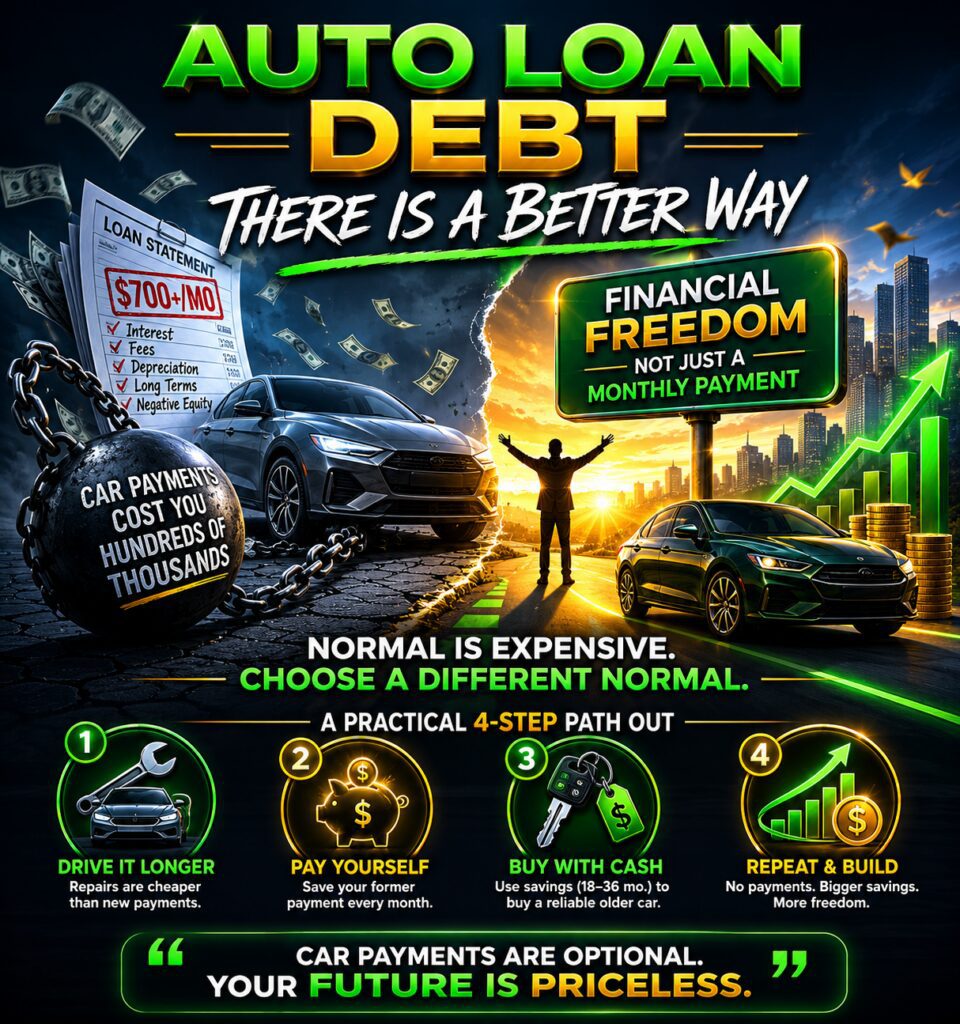
Car payments feel inevitable for many people, yet they quietly drain hundreds of thousands of dollars that could have gone toward real wealth. This is simple but radical wisdom: normal is not the same as financially smart.
The Hidden Cost of “Normal” Car Payments
Car payments have become background noise in American life: over 100 million people make them, with average new car payments around the mid‑$700s and used car payments not far behind. Loan terms routinely stretch to 72 or even 84 months, locking people into 6–7 years of debt on a rapidly depreciating asset.
Auto debt in the U.S. has swelled to more than $1.6 trillion, now larger than student loan balances and second only to mortgages as a category of consumer debt. The tragedy is that most people see this as simply “how adulthood works,” never questioning whether there is another way.
The Psychology of “Just a Monthly Payment”
Dealerships have mastered one psychological trick: shift your focus from total price to monthly payment. A $49,000 car sounds outrageous, but $772 per month feels like something that can be squeezed into the budget, especially when spread over six years.
That framing numbs your sensitivity to the true cost because you never experience the pain of parting with the full amount at once. Interest, fees, and add‑ons then quietly inflate the total you pay far beyond the sticker price, all while feeling “manageable” in monthly slices.
Depreciation, Negative Equity, and the Debt Trap
Cars lose value fast: roughly 10% the moment you drive off the lot, about 20% in the first year, and around 60% over five years. On a $49,000 car, that means it may be worth only about $20,000 after five years—while you’ve spent years making hefty payments.
Because loan balances do not depreciate with the vehicle, many people end up with negative equity, owing more than the car is worth. Nearly a third of trade‑ins now involve negative equity, with average shortfalls above $7,000 that simply get rolled into the next loan, making each new payment bigger and each term longer.
The Lifetime Opportunity Cost
The math over a lifetime is brutal. Financing cars continuously from age 25 to 65 at roughly $700 per month adds up to about $336,000 in payments, before even adjusting for interest or inflation. If that same $700 had gone into a simple index fund averaging around 8% annually, it could grow to well over $2 million across four decades.
That is the real cost of the “normal” car payment: not just the money leaving today, but the future freedom, options, and security that money could have purchased. Many people arrive at their 50s with thin retirement accounts and no idea that their driveway has been quietly siphoning their future for decades.
A Practical 4‑Step Path Out
There is, however, a realistic way to escape the payment treadmill without pretending everyone can buy a car in cash tomorrow.
- Step 1: Drive your current car longer than feels comfortable, recognizing that repairs on a paid‑off vehicle are usually far cheaper than starting a new cycle of payments.
- Step 2: When the car is paid off, keep “paying” yourself by sending that former payment into a dedicated savings account every month.
- Step 3: After 18–36 months, use the accumulated cash—often tens of thousands of dollars—to buy your next car outright, likely a solid, older, well‑maintained model rather than something brand new.
- Step 4: Repeat the saving pattern so that each future car is paid for in cash, while your savings cushion for the next one grows larger.
Within about a decade, a disciplined saver following this path can be driving a reliable $15,000–$20,000 car bought with cash and still have money set aside toward the next vehicle. At that point, car payments are no longer a necessary line item in the budget—they’re just a choice you no longer need to make.
Identity, Status, and Choosing a Different Normal
Cars are not just transportation; they are identity and status symbols, which is why many people tolerate enormous payments to drive something that “looks the part.” In practice, this often means being privately stressed and constrained while projecting an image of success that is financed and fragile.
The alternative is quieter but far more powerful: drive something modest, paid‑for, and reliable, while using the freed‑up cash to build assets and flexibility. Normal is expensive, and in the case of car payments, normal can easily consume hundreds of thousands of dollars that could have become investments, security, and freedom later in life.
The core wisdom is straightforward: car payments are not a law of nature, they are a cultural habit. Once you see them as optional—and understand the staggering opportunity cost—you gain the power to step off the treadmill and design a different financial future.
If you’re ready to make progress in your effort to take control of your finances, this is exactly the kind of work done with my coaching clients every day—clarifying priorities, creating a practical plan, and following through on it. If you’d like support with your own situation, you’re welcome to reach out anytime right here, or by email at david@everydayfinancecoach.com
