
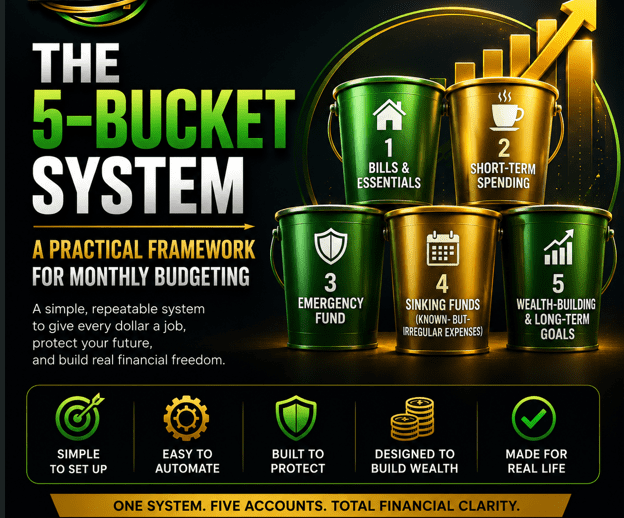
The 5-Bucket System: A Practical Framework for Monthly Budgeting
By David Samuel
Everyday Finance Coach
If you’re tired of complex budgeting methods that fall apart by week two, the 5-bucket system gives you a simple, repeatable structure that works in real life—not just in a spreadsheet.
We never want to have “lazy” money, so let’s put every dollar to work. Using this very simple budgeting framework, you create five “jobs” for your money and route cash into each one automatically. You’ll know where your money is going, and the system does most of the heavy lifting for you. You can make this really easy by using a personal finance app, such as EveryDollar, Mint or YNAB (“You Need a Budget”). Here’s how it works and how to set it up this month.
Why Use the 5-Bucket System?
Most budgets fail because they’re too detailed, too fragile, or too disconnected from how money actually flows in and out of your accounts.
The 5-bucket system solves that by:
- Reducing decisions: You tell your money where to go once, then let automation do its thing.
- Protecting goals: Money for the future lives separately from “fun” money.
- Creating clarity: At a glance, you know what’s safe to spend and what’s off-limits.
You can use five separate bank accounts, or use one bank with sub-accounts. The structure matters more than the specific bank.
The Five Buckets
1. Bills & Essentials Account
Purpose: Cover all fixed and must-pay expenses.
This account handles:
- Rent or mortgage
- Utilities and internet
- Insurance premiums
- Minimum debt payments
- Groceries and basic transportation
Your goal is to have one main account where your paycheck lands, and from which all essential bills are paid. You want enough in here to comfortably handle your monthly obligations—ideally with at least a small buffer so a slightly higher bill doesn’t throw everything off.
Rule of thumb
Aim for your essential expenses to stay within a reasonable portion of your take-home pay so you have room for savings, debt payoff, and lifestyle. If this account is always running dry, your first task is to reduce these fixed costs or increase income.
2. Short-Term Spending (Everyday & Fun)
Purpose: Handle day-to-day and “nice-to-have” spending without guilt.
This account covers things like:
- Dining out and coffee runs
- Entertainment and hobbies
- Clothing and small household purchases
- Personal care and miscellaneous spending
You fund this account with a set amount each month (or each payday), and that becomes your spendable money. When it’s gone, it’s gone—no dipping into bills or savings to extend the fun.
This is where many people find peace: you don’t have to track every latte. You just keep an eye on the balance in this one account and pace yourself. If you like, pair this with a separate debit card so you can check the remaining “fun” money instantly.
3. Emergency Fund Account
Purpose: Protect you from life’s surprises so emergencies don’t become debt.
This is a dedicated high-yield savings account, separate from all others, for:
- Job loss
- Medical emergencies
- Major car or home repairs
- Other true “unexpected and urgent” events
You don’t spend from this account for vacations, sales, or “I really want it.” It exists to keep your financial life from being derailed. If you’re just starting, don’t stress about hitting three to six months of expenses immediately. Focus first on:
- Starter goal: One month of essential expenses
- Next goal: Three months
- Long-term: Three to six months, depending on your stability and risk tolerance
Automate a modest, realistic amount into this account every month, even if it’s small. Consistency matters more than size at the beginning.
4. Sinking Funds Account (Known-but-Irregular Expenses)
Purpose: Smooth out the “surprise” costs you actually can predict.
Sinking funds are for irregular but expected expenses, such as:
- Car maintenance and repairs
- Annual insurance premiums or memberships
- Holiday gifts and travel
- Back-to-school costs
- Home maintenance
Without this account, these costs hit like emergencies and often go straight to credit cards. Here’s how to use it:
- List irregular expenses you know will happen in the next 12 months.
- Estimate their yearly total.
- Divide that total by 12 to get a monthly amount.
- Automatically send that amount into your sinking funds account.
Within that account, you can track sub-buckets on paper or in the app, like “Car,” “Gifts,” “Travel”, but all the cash can live in one high-yield savings account.
5. Wealth-Building & Long-Term Goals Account
Purpose: Build wealth and move toward financial independence.
This isn’t a single checking account; it’s a category for long-term money that lives in:
- Workplace retirement plans (401(k), 403(b))
- IRAs (Roth or Traditional)
- Taxable brokerage accounts for long-term investing
- Other long-term goal accounts (house down payment, future business, etc.)
You fund this “account” by:
- Setting automatic contributions from your paycheck into retirement plans
- Setting automatic transfers from your main account into IRAs or brokerage accounts
The key is to treat investing as a fixed monthly obligation, not a “maybe if there’s anything left.” Even a small percentage that grows over time beats waiting for the perfect moment.
Putting It All Together: How to Implement
Here’s how to set up the 5-account system in the next 30 days:
Choose your structure.
Decide whether you’ll use separate bank accounts, sub-accounts, or labeled buckets within one bank.
List your monthly take-home income.
Get clear on what actually arrives in your accounts each month.
Assign target amounts to each of the five accounts.
Start with:
- Bills & Essentials
- Short-Term Spending
- Emergency Fund
- Sinking Funds
- Investments & Long-Term Goals
Automate as much as possible.
Direct deposit into your main account. Set automatic transfers on payday into:
- Short-Term Spending
- Emergency Fund
- Sinking Funds
- Investment accounts
Adjust over the next 2–3 months.
The first version won’t be perfect. Watch where you constantly run short and where money is piling up, then nudge the amounts until the system feels realistic and sustainable.
The power of the 5-account system is that it aligns your money with your real life—today’s needs, this year’s surprises, and your long-term goals—all at once. I really encourage you to set this up in one of the apps I mentioned: EveryDollar, Mint or YNAB (“You Need a Budget”). The app will truly automate the process, while giving you full visibility to all aspects of your financial situation.
If you’re ready to make progress in your effort to take control of your finances, this is exactly the kind of work done with my coaching clients every day—clarifying priorities, creating a practical plan, and following through on it. If you’d like support with your own situation, you’re welcome to reach out anytime right here, or by email at david@everydayfinancecoach.com
